
AUGUST 26, 2026
Resource Center: European Packaging Sustainability Legislation
Updated August 26th, 2026
As we enter Q3 2026, there have been significant updates to packaging legislation in the European Union. We have updated our original Q2 2025 article to reflect ThermoSafe’s current understanding of the Packaging and Packaging Waste Regulation (PPWR) as of August 2026.
Although the PPWR entered into force in February 2025 and begins applying in August 2026, many technical aspects of the regulation will continue to be defined through implementing acts, delegated acts, regulatory guidance, and Member State implementation. As a result, certain interpretations and compliance expectations may continue to evolve.
This article summarizes ThermoSafe’s current understanding of the PPWR based on the regulation text and publicly available guidance as of August 2026. It is provided for informational purposes only and should not be considered legal advice. Companies should consult their legal and regulatory advisors to determine how the regulation applies to their specific products, packaging, and operations.
In this article, we’ll cover:
- The current status of the Packaging and Packaging Waste Regulation (PPWR) and what it may mean for temperature-controlled packaging
- Key implementation timelines and upcoming sustainability requirements
- ThermoSafe’s current understanding of pharmaceutical packaging exemptions
- Material restrictions, labeling, recyclability, and other packaging requirements under the PPWR
- Related European Union sustainability legislation, including the Omnibus I simplification package, the European Union Deforestation Regulation (EUDR), and the current status of the Green Claims Directive
Packaging and Packaging Waste Regulation (PPWR)
The Packaging and Packaging Waste Regulation (PPWR) establishes harmonized requirements for packaging placed on the EU market, including provisions related to sustainability, recyclability, labeling, reuse, and extended producer responsibility. The regulation is intended to reduce packaging waste, improve resource efficiency, and support the transition toward a circular economy across the European Union. It entered into force on February 11, 2025 and its general date of application is August 12, 2026.
General principles:
- Background
- The requirements were initially established in the Packaging and Packaging Waste Directive 94/62/EC (PPWD) and are now governed by the Packaging and Packaging Waste Regulation 2025/40 (PPWR).
- Scope
- PPWR sets standards for packaging allowed on the EU market while also addressing packaging waste management and prevention strategies.
- The regulation is intended to apply broadly to packaging placed on the EU market, including packaging materials and packaging waste, subject to the specific provisions and exemptions outlined within the regulation.
- Obligated parties
- Economic operators – entities involved in the packaging supply chain including packaging manufacturers, suppliers, importers, and distributors.
- Producers and Importers – companies that place packaging on the EU market, including manufacturers and businesses importing packaged goods
- Retailers and Distributors – businesses that sell packaged products directly to consumers or other businesses
- Requirements:
- Depending on the packaging type, application, and economic operator, PPWR introduces requirements that include:
- Designing for recyclability
- Minimum thresholds for recycled content depending on the material and format
- Maximum empty space percentages of packaging/void fill
- Restrictions on substances and certain formats
- Labelling of material composition to facilitate consumer sorting
- Targets of reusability for transport packaging
- Established harmonized extended producer responsibility
- Depending on the packaging type, application, and economic operator, PPWR introduces requirements that include:
- Exemptions
- PPWR includes exemptions from certain recyclability, recycled content, and labeling requirements for specific medicinal product packaging. The application of these exemptions to various packaging configurations, including certain temperature-controlled packaging systems, continues to be the subject of industry interpretation and evolving regulatory guidance, “where such packaging is necessary to comply with specific requirements to preserve the quality of the medicinal product” from the recyclability, recycled content and labeling requirements (if there is no space on packaging or if label could jeopardize safe use of medicinal products).
- ThermoSafe’s current interpretation of these provisions is discussed later in this article.
- Implementation
- Accompanying implementing acts detailing methodologies for calculating recyclability thresholds, recycled content minimums and other data needed for successful implementation of PPWR. Many technical details of PPWR will continue to be defined through implementing acts adopted over the coming months and years, including methodologies for recyclability performance, recycled content calculations, and other compliance requirements. The latest status of the accompanying acts for PPWR can be found on Europen’s Website through their PPWR Tracker.
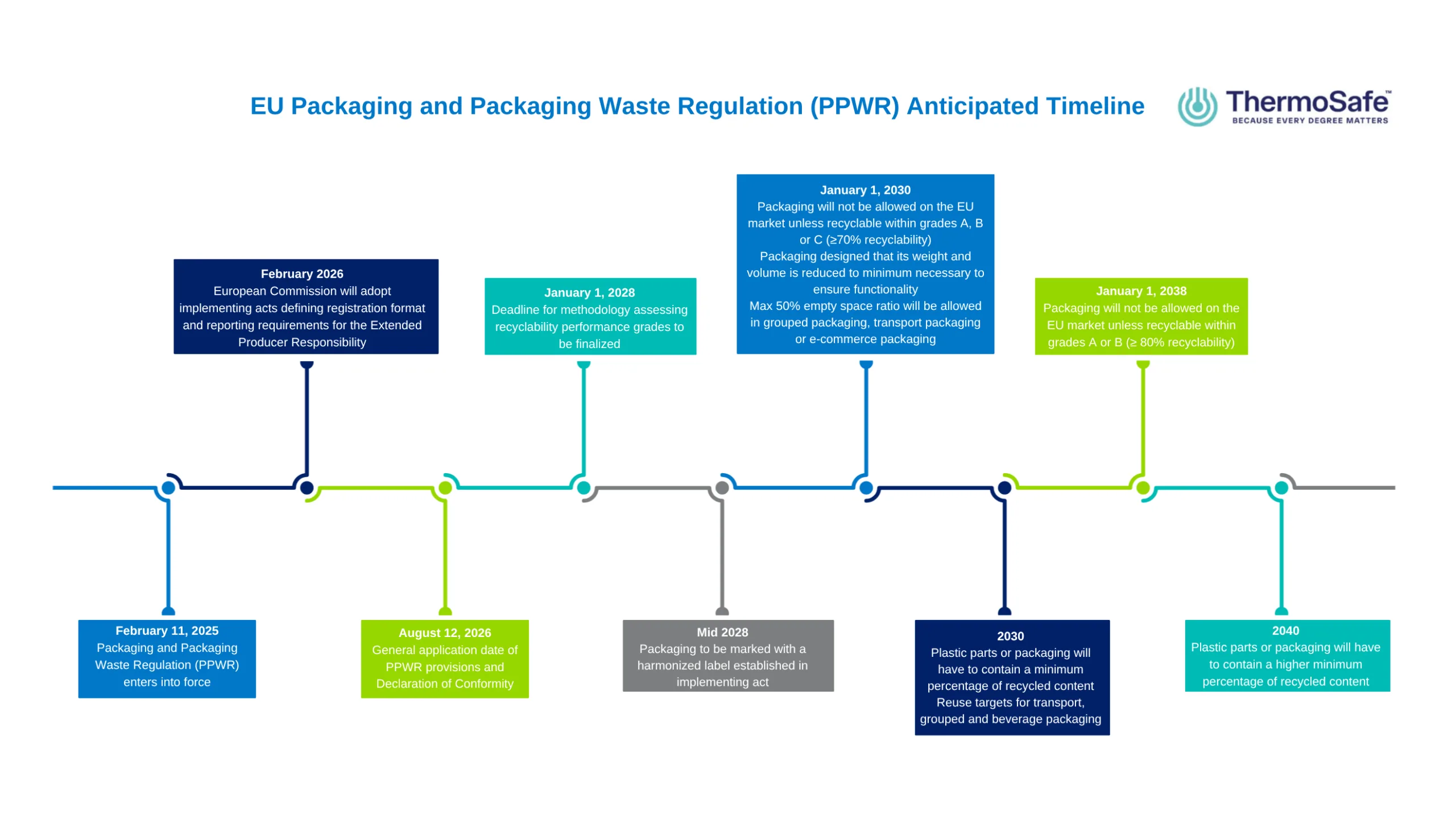
PPWR Sustainability Requirements
Based on the current text of the PPWR and implementing guidance available as of August 2026:
- Substances in Packaging (Article 5)
- Total concentrations of lead, cadmium, mercury and hexavalent chromium present in packaging or packaging components not to exceed 100 mg/kg.
- Food contact packaging containing PFASs in concentration equal to or above given limit values will be banned
- Recyclability (Article 6)
- PPWR establishes recyclability performance grades based on a package’s ability to be effectively collected, sorted, and recycled. The detailed assessment methodology will be defined through implementing acts.
- Grade A: ≥ 95% recyclability
- Grade B: ≥ 80% recyclability
- Grade C: ≥ 70% recyclability
- The methodology for assessing recyclability is targeted to be finalized by January 1, 2028, with implementation acts defining the criteria by January 1, 2030.
- Subject to the final implementing methodology,
- packaging placed on the EU market will be expected to meet the applicable recyclability performance requirements beginning in 2030.
- packaging will not be allowed on the EU market unless recyclable within grades A and B.
- Recyclability Exceptions
- PPWR identifies exemptions from certain recyclability requirements for specific packaging categories, including immediate packaging of medicinal products and certain outer packaging used to preserve product quality.
- The scope and practical application of these exemptions continue to be interpreted as implementing guidance develops.
- PPWR establishes recyclability performance grades based on a package’s ability to be effectively collected, sorted, and recycled. The detailed assessment methodology will be defined through implementing acts.
- Minimum Recycled Content in Plastic Packaging (Article 7)
- By 2030 and 2040, any plastic part of packaging will have to contain a minimum percentage of recycled content (typically post-consumer recycled content), at different levels depending on whether the packaging is or not contact sensitive
- Targets are set per packaging type and format and will be calculated as an average per manufacturing plant and year
- Recycled Content Exceptions
- PPWR identifies several packaging categories that are exempt from the minimum recycled content requirements, including:
- immediate and outer packaging of medicinal products
- packaging of suppliers, components and immediate packaging components for the manufacturing of medicinal products
- any plastic part representing less than 5% of the total weight of the whole packaging unit
- PPWR identifies several packaging categories that are exempt from the minimum recycled content requirements, including:
- Compostability (Article 9)
- By 3 years from the entry into force of PPWR, several packaging formats will need to be compostable to be allowed on the EU market.
- Formats include permeable tea, coffee or other beverage bags, single serve units which are intended to be used and disposed of together with the product, and sticky labels attached to fruit and vegetables.
- Packaging Minimization (Article 10) and Waste Prevention (Article 43)
- Packaging minimization is expected to become one of the more significant design requirements under PPWR, requiring manufacturers to demonstrate that packaging weight and volume have been reduced to the minimum necessary while maintaining product protection and functionality.By January 1, 2030
- packaging placed on the EU market shall be designed so that its weight and volume is reduced to the minimum necessary to ensure its functionality, considering its shape and material.Methodology for packaging minimization assessment includes list of performance criteria such as product protection, packaging manufacturing processes, and logistics.3 years from definition of methodology to calculate the empty space ratio, a max 50% empty space ratio will be allowed in grouped packaging, transport packaging or e-commerce packaging.
- Economic operators using reusable packaging within a system for reuse are exempt from complying with the max 50% empty space ratio.
- PPWR introduces packaging waste prevention targets for Member States which are set per capita, as compared to packaging waste generated in 2018.
- 5% by 2030
- 10% by 2035
- 15% by 2040
- Packaging minimization is expected to become one of the more significant design requirements under PPWR, requiring manufacturers to demonstrate that packaging weight and volume have been reduced to the minimum necessary while maintaining product protection and functionality.By January 1, 2030
- Packaging Restrictions (Article 25 and Annex V)
- From January 1, 2030, packaging formats listed in Annex V to the PPWR will no longer be allowed on the EU market
PPWR Information Requirements
- Labeling (Article 12)
- PPWR introduces harmonized labeling requirements intended to improve consumer sorting and provide consistent packaging information across Member States.
- Standardized markings and labels will indicate material composition, packaging reusability, as well as the percentage of recycled content and bio-based plastic content helping consumer sort packaging. The PPWR also establishes consistent waste receptacle labeling across the EU.
- Companies will have 3.5 to 4 years to comply, depending on labeling requirements linked to market access conditions.
- Labeling Exceptions
- These requirements do not apply to immediate and outer packaging of medicinal products or medical devices if space constraints exist or if labeling could compromise the safe use of medicinal products.
- Claims (Article 14)
- Environmental claims on packaging need to follow PPWR, the Empowering Consumers Directive, and applicable national greenwashing rules. The Green Claims Directive proposal remains uncertain as of August 2026.
- Claims can be made only in relation to packaging properties exceeding the applicable minimum requirements set out in PPWR
- Companies should ensure that any environmental claims are supported by appropriate technical documentation and remain consistent with evolving EU and national requirements governing environmental marketing claims.
Obligations of Economic Operators
- Reuse and refill (Article 11)
- PPWR will introduce reuse targets for packaging used for different applications such as for transport and beverage from January 1, 2030
- Transport, grouped and beverage packaging are applicable categories including pallets, foldable plastic boxes, trays, plastic crates, intermediate bulk containers, pails, drums and canisters, pallet wrappings or straps
- Reuse Exceptions:
- There are many exemptions including cardboard boxes, packaging used to transport dangerous goods, large-scale machinery, flexible formats that are in direct contact with food, feed or food ingredients.
- Extended Producer Responsibility
- Additional implementing acts are expected to define the registration format, reporting requirements, and other operational aspects of the harmonized Extended Producer Responsibility system. ThermoSafe is monitoring the status of these implementing acts and related Member State register requirements.
- Within 18 months of the implementing acts being adopted, Member States must establish a register to monitor producer compliance with Extended Producer Responsibility (EPR) requirements.
- It remains to be determined when the obligation for packaging producers to register in each Member State (where they make packaging or packaged products available) will begin
- Modulation of EPR fees based on packaging recyclability performance grades and recycled content
- Declaration of Conformity (Article 39)
- To demonstrate compliance with the PPWR, economic operators (manufacturers, suppliers, importers and distributors) placing packaging on the market will need to carry out a conformity assessment procedure and draw up technical documentation that they will need to keep for 5 – 10 years and present to market surveillance authorities when requested.
- The manufacturer or importer of packaging needs to prepare a Declaration of Conformity (DoC) and internal supporting technical documentation before placing packaging on the European Union market. The DoC and technical documentation are prepared to be provided within 10 days of receipt of a request from a Member State national authority.
Outlook
The PPWR takes precedence over existing European Union packaging directives or national laws including the Single Use Packaging Directive (SUPD), Packaging and Packaging Waste Directive (PPWD), and Waste Framework Directive. PPWR will also establish a harmonized Extended Producer Responsibility (EPR) scheme. As the PPWR general application date of August 12, 2026 takes effect, economic operators are working diligently to prepare the required technical documentation and declarations of conformity. As of August 2026, the DoC should address compliance with heavy metals limits under Article 5, include a general recyclability assessment aligned with EN 13430:2004 or other technical specifications, and identify the packaging manufacturer and supplier. As additional implementing acts and methodologies are developed and adopted, technical documentation and DoCs are expected to expand to capture the additional required information.
Looking Ahead
PPWR represents one of the most significant changes to packaging regulation in the European Union in decades. While the regulation establishes the overall framework, many of the technical methodologies, implementing acts, and Member State processes needed for full implementation are still being developed.
As a result, companies should anticipate compliance expectations to continue evolving over the coming years. ThermoSafe is actively monitoring these developments and will continue updating this resource as additional guidance becomes available.
Pharmaceutical
Current interpretation (August 2026)
PPWR includes exemptions from certain recyclability, recycled content, and labeling requirements for specific medicinal product packaging. However, based on ThermoSafe’s current understanding of the regulation and the information available as of August 2026, the application of these exemptions to temperature-controlled packaging remains subject to interpretation.
ThermoSafe currently takes a conservative view that temperature-controlled packaging used for pharmaceuticals, biologics, or medical devices may ultimately be required to comply with applicable PPWR requirements, including recyclability performance, recycled content, and labeling obligations, unless future guidance or implementing acts clarify the scope of the exemption.
ThermoSafe will continue to monitor regulatory developments and update this guidance as additional clarification becomes available.
Transport/Protective
Based on ThermoSafe’s current interpretation of the PPWR, transport packaging supplied to consumers is expected to be subject to applicable PPWR requirements, including recyclability performance, recycled content, and labeling obligations.
Business-to-business (B2B) transport packaging is also regulated under the PPWR, although different provisions apply. Depending on the packaging type and use case, requirements may focus on durability, reuse systems, and recyclability performance rather than consumer-facing obligations.
Material Bans and Labeling Requirements
While the PPWR is consuming much of the conversation regarding European packaging legislation, there are some other noteworthy regulations and key changes detailed below.
Material Bans
Proposed Styrene Polymer Ban – France
There was a proposed ban in France for nonrecyclable styrene compounds that would have gone into effect on January 1, 2025. This proposed ban has since been removed in favor of alignment with the PPWR. The original ban statement was included in Article 23 of the August 2021 version of the French Climate and Resilience Act. As of May 2025, this statement and proposed ban has been removed from the French Climate and Resilience Act and also not incorporated into the French Environmental Code within Article L541-15-10.
In summary, the proposed French restriction on styrene compounds is no longer moving forward. Packaging placed on the EU market will instead be governed by the broader recyclability framework established under the PPWR.
Oxo-Degradable Additive Ban
Oxo-degradable plastics were effectively banned in the EU on July 1, 2021, implemented through the Single-Use Plastics Directive (Directive 2019/904).
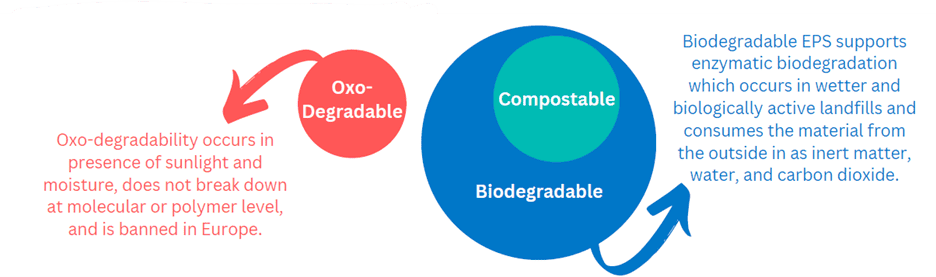
It is important to differentiate between oxo-degradable, biodegradable and compostable. Oxo-degradable additives cause conventional plastics to break down and disintegrate into small pieces. Biodegradability refers to the ability to be broken down into simpler compounds by microorganisms, as part of the natural biological process of decomposition. Compostability refers to the ability to decompose under specific conditions into natural, non-toxic components like carbon dioxide, water, and biomass, leaving no harmful residues. While all compostable materials are biodegradable, not all biodegradable materials are compostable. Biodegradable materials may break down in the environment, but not necessarily into compost and may not provide nutrients to the soil. ThermoSafe’s Biodegradable EPS is not oxo-degradable. Instead, this innovative material can be recycled via drop-off programs alongside standard EPS or it can enzymatically biodegrade over 90% within four years in a microbial-rich landfill environment.
Labeling Requirements
PPWR Labeling
The PPWR includes requirements (Articles 12 + 13) for certain information to be included on labels including information of proper disposal, recyclability, and harmonized EU-wide separation instructions with easily understandable graphics. The PPWR also contemplates the use of digitally provided information, such as QR codes, for certain packaging information, subject to the applicable requirements and implementing acts.
The PPWR establishes labeling requirements that may include the following information, depending on the packaging type and applicable provisions:
- Packaging material composition
- Participation in a deposit system
- Packaging reusability
- Harmonized criteria for labeling recycled & bio-based plastic proportions
- Substances of concern
- EPR system participation
- Prohibition of misleading and confusing labeling
- Waste container for correct disposal
Where applicable, the following information may be provided digitally through QR codes or similar technologies:
- Manufacturer name, registered trade name or registered trademark + contact
- Waste stream information for each individual packaging component
- Recycled content information
- Reusability information (availability of location, national, or EU-wide reuse system), information on collection points, and simplification of packaging tracking and rotation calculations
- Packaging labeling that is part of an EPR system
- Identification of substances of concern
Sustainability Reporting and Claims
Omnibus Package, CSRD and CSDDD
The EU sustainability reporting landscape has changed significantly following adoption of the Omnibus I simplification package. The package was first published by the European Commission on February 26, 2025 as a set of measures to reduce regulatory burden, streamline sustainability reporting, and simplify due diligence obligations. As of August 2026, the Omnibus I amendments have been adopted and are in force, while implementation continues through Member State transposition, revised European Sustainability Reporting Standards (ESRS), and future practical guidance.
Corporate Sustainability Reporting Directive (CSRD)
Following adoption of the Omnibus I amendments, the CSRD’s mandatory scope has been significantly narrowed and generally applies to EU companies with more than 1,000 employees and more than €450 million in net annual turnover. For certain non-EU companies, the updated requirements apply where the group generates more than €450 million in net turnover in the EU and meets applicable EU subsidiary or branch thresholds.
The Corporate Sustainability Reporting Directive (CSRD) was adopted to improve transparency and consistency in corporate sustainability reporting across the EU. It requires in scope companies to report on environmental, social, and governance (ESG) matters and to assess double materiality, including both how the company affects people and the environment and how sustainability risks may affect the company’s financial position.
Following the Omnibus I amendments, the CSRD’s mandatory scope has been significantly narrowed. Later wave CSRD reporting obligations were delayed through the “stop-the-clock” measures and then narrowed through the Omnibus amendments, so many companies previously expected to report may no longer be directly in scope. However, smaller companies may still receive sustainability information requests from customers, investors, or other business partners..
European Sustainability Reporting Standards (ESRS)
Companies that remain in scope must report sustainability information under the ESRS. In July 2026, the European Commission adopted revised, simplified ESRS and a voluntary sustainability reporting standard for smaller companies outside mandatory CSRD scope. The revised ESRS are intended to reduce administrative burden, streamline materiality assessments, and reduce the number of mandatory datapoints while preserving high-quality sustainability disclosures. The voluntary standard is also intended to support a “value chain cap,” limiting the sustainability information that in scope companies may request from smaller companies in their value chain.
Corporate Sustainability Due Diligence Directive (CSDDD)
The Corporate Sustainability Due Diligence Directive (CSDDD) entered into force on July 25, 2024 and creates a framework for large companies to identify and address actual and potential adverse human rights and environmental impacts in their operations and value chains.
Following the Omnibus I amendments, the CSDDD’s direct scope has also been narrowed to very large companies. The directive now generally applies to EU companies with more than 5,000 employees and more than €1.5 billion in net turnover, and to non-EU companies generating more than €1.5 billion in net turnover in the EU. Member States must transpose the amended directive into national law by July 26, 2028, and in-scope companies are generally expected to begin complying by July 26, 2029. Micro companies and Small and Medium-sized Enterprises (SMEs) remain outside the direct CSDDD scope, although they may still be affected indirectly through customer or value-chain due diligence requests.
European Union Deforestation Regulation (EUDR)
This EU Deforestation Regulation (2023/1115) is a policy framework that entered into force on June 29, 2023. It is aimed at preventing deforestation caused by products consumed in the EU. The due diligence reporting requirements apply to cattle, cocoa, coffee, palm oil, rubber, soy, and wood. Companies who place these commodities on the EU market, or exports from it, must be able to prove that the products do not originate from recently deforested land or have contributed to forest degradation.
Following subsequent legislative amendments, the implementation timeline has been revised as follows:
- December 30, 2026: Compliance required for large and medium operators, and for micro and small operators already covered by the EU Timber Regulation.
- June 30, 2027: Compliance required for micro and small enterprises that are not subject to the earlier timber-related deadline.
Key information requirements of EUDR include precise geolocation coordinates of the land where commodities were produced, date or time range of production, supply chain transparency, deforestation-free verification, and due diligence statement.
The Commission has also adopted simplification measures to support implementation. These include updated guidance and FAQs, simplified obligations for certain downstream operators and micro or small primary operators, and rules for the EUDR Information System used to submit due diligence statements and simplified declarations.
In the context of packaging and packing materials, packing material placed or made available on the market or exported as products in their own right and containers which give a product its essential character are subject to EUDR. Packaging used solely to support, protect, or transport another product generally falls outside the scope of the EUDR, whereas packaging placed on the market as a product in its own right may fall within scope.
Green Claims Directive
The Green Claims Directive was proposed in March 2023 to address greenwashing and misleading environmental claims. However, in June 2025, the European Commission announced its intention to withdraw the proposal, and negotiations were cancelled. As of August 2026, the proposal remains uncertain and should not be treated as an active, near-term compliance obligation in the same way as adopted EU legislation.
The uncertainty around the Green Claims Directive does not remove greenwashing risk. The Empowering Consumers for the Green Transition Directive is already in force, with Member States required to transpose it by March 27, 2026 and apply the rules from September 27, 2026. These rules restrict generic environmental claims, sustainability labels that are not based on approved certification schemes or public authority systems, and certain climate-related claims based on offsetting. Packaging-related environmental claims must also be consistent with PPWR Article 14 and supported by technical documentation where applicable.
Summary
The European packaging regulatory landscape continues to evolve as the PPWR moves into implementation and related sustainability legislation continues to develop. While many core requirements are now established, additional implementing acts, regulatory guidance, and Member State interpretation will continue to shape how the regulation is applied in practice.
ThermoSafe will continue to monitor these developments and update this resource as new guidance becomes available. Our goal is to help customers understand emerging regulatory requirements and prepare for potential impacts on packaging design, qualification, and compliance planning.
As always, companies should work with their legal and regulatory advisors to determine how these evolving requirements apply to their specific products, packaging, and operations.
[1] Please note that ThermoSafe’s interpretation is not meant to constitute legal advice, and ThermoSafe assumes no responsibility for the decisions made by producers in determining their obligations. We suggest that companies work with their legal teams to review the relevant statutes, rules and regulations to determine their responsibilities.
Need to get up to speed with USA’s EPR regulations as well? Review the comprehensive EPR blog post that is being updated regularly.