
APRIL 30, 2026
Are Your Cold Chain Packaging Decisions Based on Facts – or Assumptions?

How to Evaluate Sustainability, Science, and Real-World Performance in Temperature-Controlled Packaging
Cold chain packaging decisions carry real consequences. They impact not only product integrity, but also patient safety, operational efficiency, cost, and increasingly – your organization’s sustainability footprint.
Yet many of these decisions are still made based on headline claims, incomplete data, or long-standing assumptions.
At our recent masterclass, “Protect Your Medicines & Patients: How to Evaluate Your Cold Chain Packaging is Sustainable & Science-Backed Through to the Last Mile,” we explored a better approach – one grounded in evidence, transparency, and real-world alignment.
Here’s what every pharmaceutical and life sciences team should be thinking about.
1. Sustainability: Looking Beyond the Label
Sustainability is now firmly on the agenda at every pharma and biotech manufacturer and their partners. But – evaluating it isn’t always straightforward.
Many packaging solutions are marketed with claims like:
- “100% recyclable”
- “Environmentally friendly”
- “Biodegradable”
At face value, these sound compelling. But without context, they can be misleading or incomplete.
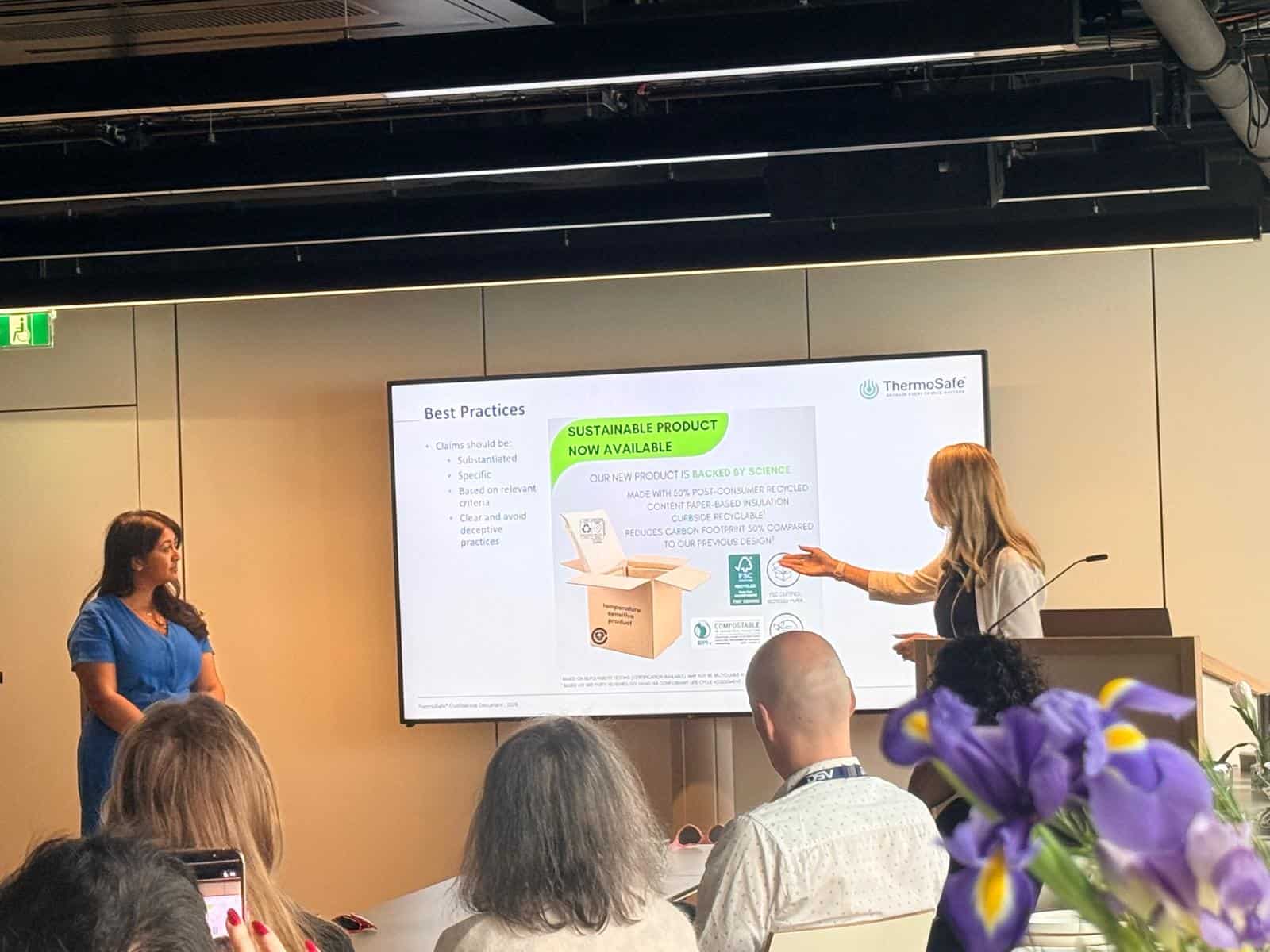
During the session, we challenged attendees to dissect these claims. What quickly became clear is that many sustainability statements:
- Lack clear definitions (what part of the packaging?)
- Omit supporting data or certification
- Focus on individual components rather than the full system
For example, insulation might be recyclable – but what about the full pack-out? Gel packs? Outer packaging? End-of-life reality?
The takeaway:
Sustainability claims must be:
- Substantiated with credible data (e.g., lifecycle assessments)
- Specific about what is being measured
- Comparable across solutions
- Transparent, avoiding vague or exaggerated language
Several attendees shared that this was a key learning – recognizing that suppliers don’t always present the full picture. Asking deeper questions is essential to uncovering the truth behind the claim.
2. Science-Backed: What the Data Really Tells You
Performance claims are everywhere in cold chain packaging – “48 hours,” “72 hours,” “96 hours.”
But what do these numbers actually mean?
One of the biggest areas of discussion in the masterclass centered on how performance data is generated – and whether it’s truly comparable.
Attendees asked insightful questions:
- Were the tests conducted in ISO-certified labs?
- Were the same variables controlled across comparisons?
- What protocols and profiles were used?
These questions get to the heart of what “science-backed” really means.
Because a performance claim is only meaningful when you understand:
- The test profile (e.g., ISTA 7D, ISTA 7E)
- The payload used and whether it reflects reality
- The testing conditions and mapping methodology
- Whether results represent best case, average, or worst case
To truly compare solutions, you need a controlled approach:
- Same profile
- Same lab
- Same payload
- Same protocol
- Same conditions
Only one variable should change: the packaging itself.
In one example shared, two PCM-based shippers with similar materials and claims performed very differently:
- One failed at ~75 hours
- The other maintained temperature for 112.5 hours – over 50% longer

The implication is clear:
Similar claims do not equal similar performance.
Some organizations run their own validation to confirm supplier claims—but as many attendees noted, that’s not always feasible. Especially early in supplier selection, teams must rely on supplier data.
That makes it critical to ask the right questions upfront—and demand transparency.
3. In Practice: Where Assumptions Break Down
Even with good intentions, packaging decisions are often guided by assumptions. During the session, we explored three of the most common – and why they can lead teams astray.
Assumption 1:“If it passes a standard profile, it will work for my supply chain.”
Industry standards like ISTA 7D and 7E are valuable benchmarks. But they are not always representative of real-world conditions.
In one example, a solution designed for a summer profile aligned with actual shipping conditions for only a fraction of the year – while being misaligned the majority of the time.
The risk:
Designing for the wrong conditions can lead to:
- Over-engineered packaging
- Increased cost and weight
- Higher risk of temperature excursions


The better question is:
Does this test reflect my actual shipping lane and conditions?
Assumption 2: “Similar materials and claims mean equivalent solutions.”
It’s easy to assume that two shippers using similar materials (e.g., EPS, VIP, PCM) will perform similarly.
But as the controlled comparison demonstrated, performance can vary significantly – even when everything appears equivalent on the surface.
The difference lies in:
- System design
- Pack-out configuration
- Testing rigor
- Data transparency
Headline claims only tell part of the story.
Assumption 3: “Sustainable solutions cost more.”
This is one of the most persistent myths – and one of the most important to challenge.
While some solutions (like PCM systems) may have a higher upfront cost, the long-term picture often looks very different:
- Lower cost per use over time
- Reduced freight due to optimized pack-out
- Lower risk of excursions
- Improved sustainability outcomes
In one example, a PCM solution delivered 34% cost savings over time, despite a higher initial investment.
The takeaway:
The lowest upfront price is not the same as the lowest total cost.
From Trade-Offs to Balance
A common belief in cold chain packaging is that you must trade-off between:
- Performance
- Cost
- Sustainability
But the reality is more encouraging.
When packaging is properly aligned to the specific lane, product, and conditions, it’s possible to improve all three simultaneously:
- Reduce risk
- Optimize cost
- Lower environmental impact
The key is not choosing the “best” packaging in general – but the right packaging for your specific application.
Key Questions to Ask Before You Decide
To move from assumptions to confidence, ask:
- Are sustainability claims specific and substantiated?
- Does the performance data reflect real-world conditions?
- Are comparisons truly apples-to-apples?
- What variables were controlled in testing?
- What is the total lifecycle cost, not just upfront price?
- What might my supplier not be showing me?
Conclusion: From Claims to Confidence
Cold chain packaging is too critical to rely on assumptions or marketing claims alone.
The organizations that get it right are those that:
- Demand transparency
- Prioritize data over headlines
- Align decisions with real-world conditions
Because ultimately, this isn’t just about packaging.
It’s about protecting medicines, safeguarding patients, and building supply chains you can trust.

Stay connected
Subscribe to our newsletter for more insights on cold chain performance, sustainability, and best practices – or reach out to continue the conversation with our experts.
Learn More about ThermoSafe Solutions
Looking for right size, right duration shipping solution, yet sustainable? Learn more about Orion Express that checks both boxes.